What is fast fashion?
We earn more and spend more money on clothing
The percentage of income spent on clothing in Europe has risen from 2 - 5% of disposable income to 10 - 15% of disposable income.
A continuous, rapid stream of new clothing trends
The rise of fast fashion companies such as H&M and Zara since the 1990s has accustomed consumers to a continuous stream of new clothing trends.
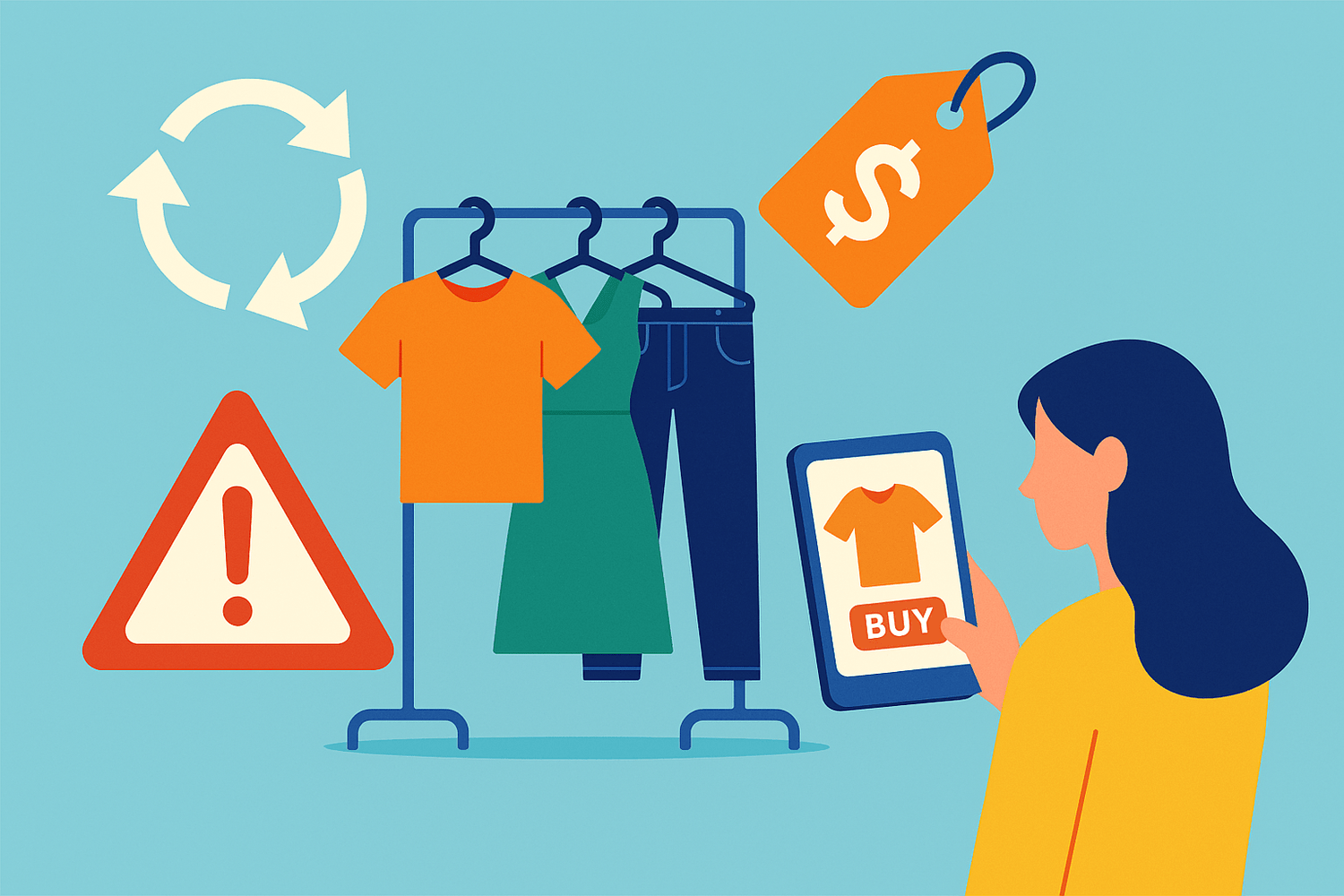
We are constantly tempted and influenced to make purchases online
Through social media and the power of influencers, consumers can be constantly influenced through the timelines on their accounts by increasingly rapidly successive clothing trends.
Fast fashion clothing is often of poor quality
The large fashion chains are concerned with only one thing: profit! This profit depends on our desire to wear new clothes. So why not encourage this desire a little? Large chains produce hundreds of millions of garments every year. The sooner these clothes wear out, the sooner we return to the store to buy new ones. Because textiles have to be made increasingly cheaply, quality is the first thing we compromise on.
The conditions under which fast fashion clothing is produced are often problematic. Approximately 47 million people worldwide work in the clothing industry, 85% of whom are women. Much of the clothing is produced in sweatshops in low-wage countries under appalling conditions. Most seamstresses do not earn a living wage, resulting in inhumane working weeks. In Asian clothing factories, seamstresses often work 60 to 90 hours per week.
The environmental impact of fast fashion is enormous
Producing 1 cotton T-shirt requires 2,500 litres of water and 20 cl of chemicals. A pair of jeans requires 7,000 litres of water. Global cotton production uses 22.5% of insecticides and 10% of pesticides of the total amounts used worldwide. Production therefore takes place on a gigantic scale and at a rapid pace. Unfortunately, much of this production remains unsold. Of the 950 million garments that entered the Dutch market in 2020, 790 million were sold. That means 160 million garments remained unsold, which effectively means wasted resources. This figure is expected to rise further because of fast fashion.
This fast fashion clothing is often thrown away afterwards
In the Netherlands, we throw away 235 million kilos of textiles every year, of which only 28 kg (2018) ends up in charity shops. Of the 40 garments every Dutch person discards each year, 24 end up as waste.
All of this comes at a heavy price. A price largely paid behind the scenes by people in developing countries and by our environment. A price that was previously invisible to consumers, but is now fortunately becoming increasingly clear.
Slow fashion is on the rise!
How can you become a more conscious consumer? It starts with educating yourself, reading up on the subject and mainly being open to change. Buy sustainable and fair clothing! Buy locally, buy second-hand and buy from independent designers. If we do this, we can make a difference together. Slow fashion is on the rise, and its 'frumpy' image is outdated.
Moving towards slow fashion together
Fortunately, the movement of producers and consumers who want to change this damaging fashion system is growing. No more mass production, but sustainable fashion that lasts a long time, places little strain on the environment and is produced under humane conditions.
More and more initiatives are emerging that each contribute in their own way to making the clothing industry more sustainable. We have listed a number of fashion alternatives for you. Vintage, fair, green or vegan fashion - what matters most to you?
Vintage fashion is a sustainable alternative to fast fashion. If you reuse someone else's clothing, no new resources need to be used and the clothing does not have to be produced (under poor working conditions). Fortunately, the range of vintage clothing has grown considerably in recent years.
Green fashion is another alternative that contributes to the movement towards slow fashion. The main goal of green fashion is to reduce the burden the fashion industry places on the environment. There are various ways to make fashion more sustainable. The quality of the clothing, the materials used, the energy consumption for production and its transport all play a determining role.
If you would still like to buy something new, you can focus on fashion brands that sell Fair Trade fashion. Fair Fashion focuses on fair clothing produced under humane conditions. This may be in a developing country, but also, for example, in the Netherlands by people who are distanced from the labour market.
Choose the clothing container, not the rubbish bin!
Have you grown tired of a garment or has it become worn out? Then certainly do not throw it away with the rubbish, because there are still plenty of useful purposes for it! Unfortunately, every year in the Netherlands, we throw away around 135 million kilos of textiles. Unfortunately, only about a quarter of this is recycled. And that is despite the fact that even damaged clothing can still be reused. Find a container near you, or take your bag of old clothes to an H&M store. In short, complete the slow fashion cycle!





Leave a comment
All comments are moderated before being published.
This site is protected by hCaptcha and the hCaptcha Privacy Policy and Terms of Service apply.